£0.00
(0 items)
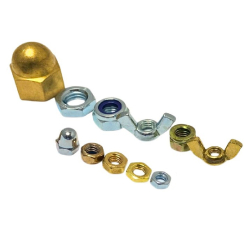
Typically paired with bolts or threaded rods, Nuts are a fastener which are commonly used to secure objects together in various applications. Nuts come in many sizes, shapes, and materials to suit different applications.
Masons stock a range of different types of nuts in various materials and finishes, including some of the types below.
Explore some of our range here, or, We're contantly updating our site with our stock lines - if what you're looking for isn't listed on our website yet, contact us for a quote!
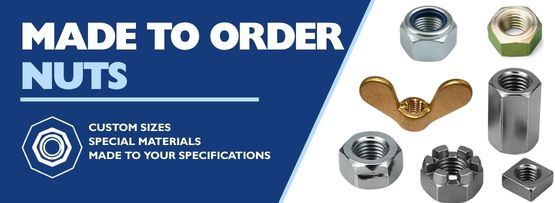
If your item is hard to find, unusual or special? Explore our Special Fasteners service for custom fasteners made to order.
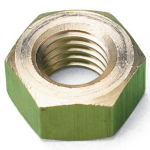
Full Nut: The most common, Hexagonal Nut used with Bolts and Set Screws
Explore our online Hex Full Nut range. We're contantly updating our site with our stock lines - if you can't find the product you're looking for on our website yet, contact us for a quote!
Nyloc Nut: A self-locking nut featuring a nylon insert. The nylon collar in the top portion of the nut locks it in place by squeezing the threads of a bolt or screw as the nut is tightened, creating friction which prevents loosening. Re-usable to an extent but efficiency decreases with every use, over-time will become ineffective.
Can be used at temperature extremes of between -40C to 120C.
Explore our online Nyloc nuts range in our Locking Nuts section. We're contantly updating our site with our stock lines - if you can't find the product you're looking for on our website yet, contact us for a quote!
Flange Nuts: A hexagon full nut with an integrated washer, the flange provides an additional surface area to spread the load, reducing pressure in one spot.
Reducing the chances of damage greatly. They are also available with serrations on the underside of the flange preventing loosening.
Lock Nuts : Also known as half nuts, jam nuts and thin nuts. Lock nuts are used alongside a full nut to keep it in position and stop it from working loose under vibration. Explore our online half nuts range in the Hex Nuts section. We're contantly updating our site with our stock lines - if you can't find the product you're looking for on our website yet, contact us for a quote!
Dome Nuts: Dome Nuts are a special hexagonal nut that features a rounded, enclosed top. They protect threads from damage and external debris, while covering sharp edges to improve safety and provide a finished, aesthetic appearance. Commonly used in automotive, electricals, furniture, and machinery. They are available standard, or with Nylon Inserts for locking in high-vibration environments.
Explore our online Dome Nuts range. We're contantly updating our site with our stock lines - If you can’t find the product you’re looking for on our website yet, contact us for a quote!
Wing Nuts: Wing nuts are specialized fasteners featuring two, wing-shaped tabs on opposite sides of a threaded, central nut. Designed for easy, tool-free tightening and loosening by hand. Ideal for applications requiring frequent, quick adjustments or disassembly. Some Wing Nuts have rounded wings (often referred to as "European/German" type) and others feature flatter/squared off wings (often referred to as American type) this is primarily due to differences in manufacturing processes.
Explore our online Wing Nuts range. We're contantly updating our site with our stock lines - If you can’t find the product you’re looking for on our website yet, contact us for a quote!
Metal Self Locking Nuts: Sometimes referred to as a bent beam nut or All-Metal Locking Nut, these nuts create friction between the threads, which causes a distortion of the threads locking it in place. Used in environments where vibration may be a problem. They will lose their locking ability after a few uses. Common brands are Aerotight, Cleveloc, Philidas, Philidas Turret, Stover and Binx nuts.
Explore our online Metal Locking Nuts range in our Locking Nuts section. We're contantly updating our site with our stock lines - if you can't find the product you're looking for on our website yet, contact us for a quote!
Weld Nuts: welded onto another object.
Hex Connector Nuts: hexagon nuts which connect two lengths of studding or threaded bar. The length of the nut is most commonly 3x diameter.
Square Roofing Nuts: Square nuts used with roofing bolts.
Cage Nuts: Also known as captive nuts. Square nuts held inside a spring steel cage. The cage features two wings which are compressed allowing installation into a hole. When installed the wings release and the outward pressure of the spring holds the cage nut in position.
Castle Nuts: Slotted Hexagon nuts with turrets on the top, which resemble a castle wall, they are used with bolts that have a hole through the end which a pin (such as a cotter or spring pin) can pass through to lock into position and prevent rotation.
Slotted Nuts: alike to Castle nuts, also feature a turret top, however the castellated section diameter is the same as the main wrenching section (which is slightly smaller in a castle nut).
Still unsure? This is just some of our range. Contact us with your request, we’ll be happy to source for you!
If your item is hard to find, unusual or special? Explore our Special Fasteners service.